
UsedBookR.com,22/C Goutham Nagar, palani goundan pudur Vadamadurai post, Coimbatore, Tamilnadu, India - 641017
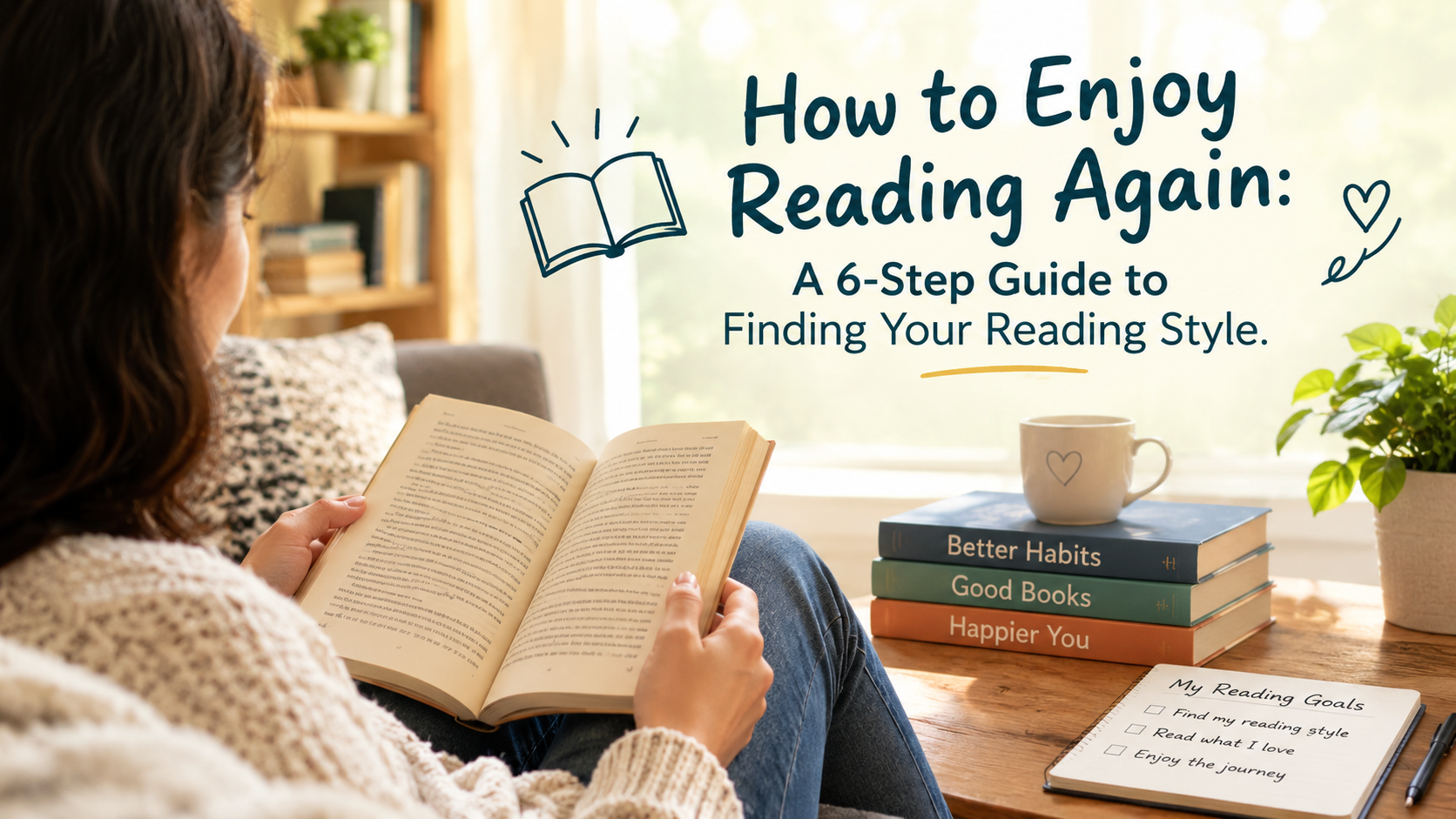
Have you ever started a book with excitement, only to put it
aside after a few pages? Perhaps you keep checking your phone, forget what
happened the last time you read, or feel tempted to skip ahead to find out how
the story ends.
If this sounds familiar, you might think you lack discipline
or aren't a natural reader.
Some people read to discover what happens next. Others read
to experience a story slowly. Many enjoy books but struggle to stay connected
when everyday responsibilities interrupt their reading.
The solution isn't always to read more. Sometimes, it's to
change how you read before deciding what to read.
At UsedBookR, we believe reading should fit your
life rather than become another task on your to-do list. Here's a simple
six-step framework to help you understand your reading style, choose books more
thoughtfully, and enjoy reading at your own pace.
Before choosing your next book, spend a moment understanding
why reading feels difficult.
Ask yourself these three questions.
1.
What usually happens when you try to read?
·
I can't concentrate for more than a few pages.
·
I forget what happened during my previous
reading session.
·
I feel restless and want to do something else.
·
I become sleepy before I make much progress.
·
I get curious, impatient, or anxious about what
happens next.
2.
When do you usually read?
·
At night, before sleeping.
·
In the morning, when my mind feels fresh.
·
During short breaks throughout the day.
·
During long, uninterrupted periods.
3.
Do you jump ahead or peek at the ending?
·
Yes, I want to know what happens.
·
No, I enjoy discovering the story as I go.
·
Sometimes, depending on the book.
Your answers can reveal useful patterns.
If you struggle to concentrate, you might need shorter
reading sessions. If you forget the story between sessions, a simple recap
could help. If you constantly peek ahead, you might enjoy reading with a
question that keeps you connected to the unfolding story.
There is no right or wrong answer. The goal is to understand
your reading experience without judging yourself.
People don't all read for the same reason. For a practical
starting point, try identifying which of these three reading styles sounds most
like you.
You want to know where the story is going.
You might become impatient with long introductions, prefer a
clear direction, or feel tempted to read the final chapter before finishing the
book.
What may help: Give each session a small question to follow.
Instead of rushing to the ending, read to discover one new piece of
information, one change in a character, or one clue about what might happen
next.
You enjoy atmosphere, emotions, relationships, and the
feeling of being immersed in another world.
You may dislike spoilers and prefer to let a story unfold
naturally rather than rush through it.
What may help: Slow down and pay attention to the
characters, language, images, and emotions. You don't need to analyse every
page or reach a particular chapter target.
You enjoy reading, but your day doesn't always cooperate.
You might read five pages on Monday, return to the book on
Thursday, and struggle to remember what happened. You may have several
unfinished books simply because your routine keeps changing.
What may help: Build continuity instead of relying on
memory. Leave yourself a one-line recap at the end of every session, along with
a note about what you want to follow when you return.
You may recognise yourself in more than one category. That's
completely fine. These are practical descriptions, not permanent labels. Your
reading style can change depending on the book, your schedule, and how you
feel.
This is where small changes can make reading feel much
easier.
Instead of asking, "Which book should I read
next?", first ask, "What would make reading easier for me
today?"
Try these methods based on your biggest difficulty.
|
Your reading
challenge |
A method to
try |
|
Difficulty
concentrating |
Read 3–5
pages at a time, then pause |
|
Forgetting
the story between sessions |
Write a one-line recap before
stopping |
|
Rushing to
find out the ending |
Focus on one
question about the current chapter |
|
Feeling
restless |
Choose a short passage or a
self-contained story |
|
Feeling
mentally tired at night |
Try calmer,
less plot-intensive reading |
|
Overthinking
while reading |
Notice one emotion, image, or
detail that stands out |
These methods don't need special equipment, a reading app,
or a complicated tracking system.
For example, if you keep forgetting what happens in a novel,
don't force yourself to remember every character and detail. At the end of a
session, simply write:
"The main character has just
discovered that her closest friend is hiding something."
When you return, you have somewhere to begin.
If you frequently jump ahead, try asking, "What does
the character want right now?" This gives your attention something to
follow without requiring you to know the ending.
And if five pages are all you can comfortably read today,
let five pages be enough.
Many people turn reading into a performance.
They count books finished, compare their progress with other
readers, and feel guilty when they go several days without opening a book.
But reading doesn't always need to be about productivity or
self-improvement.
Before you begin, choose one simple purpose.
If you want to unwind:
"I am reading to enjoy a
quieter part of my day."
Choose something that feels comfortable rather than
demanding. You don't need to take notes or extract a lesson from every page.
If you want to stay connected to a story:
"I am reading to find out
what happens to these characters."
Focus on the story's immediate developments instead of
worrying about how quickly you're progressing.
If you want to think more deeply:
"I am reading to explore one
idea."
This works well for essays, biographies, history, and
non-fiction. You can pause to reflect on a passage without feeling the need to
remember the entire chapter.
If you want something gentle:
"I am reading to experience a
few moments of calm."
A familiar story, a short chapter, or a reflective piece
might suit that purpose.
Your reason can change from one session to another. You can
read a business book on Monday to learn something new and a light novel on
Tuesday simply because you enjoy it.
Most importantly, you are allowed to stop when your purpose
has been fulfilled. Finishing a chapter isn't a requirement for having a
worthwhile reading session.
Now you can choose what to read.
Genre matters, but so do pace, emotional intensity, length,
and the kind of attention a book asks from you.
Think of this as choosing a book that suits your current
energy rather than following a strict set of rules.
Low-intensity reading: When you want something gentler
Consider character-driven novels, short stories, essays,
reflective writing, or gentle memoirs.
These can be good starting points when you want to read
without constantly tracking complicated plot twists or multiple storylines.
Your reading question: "What feeling or detail stands
out to me in these pages?"
If you enjoy character-driven novels, short stories, or
reflective writing, explore our collection of fiction books and choose a story that matches
your interests.
Medium-intensity reading: When you want to be engaged
Consider literary fiction, historical fiction, travel
writing, or narrative non-fiction.
These books can offer a sense of discovery while giving you
room to reflect on people, places, events, and ideas.
Your reading question: "What is changing, and why does
it matter?"
Choose a story or subject that makes you curious enough to
return to it.
High-intensity reading: When you want momentum
Consider thrillers, fast-paced mysteries, suspense novels,
or action-packed stories.
These can be especially appealing when you want a strong
reason to keep turning the pages.
Your reading question: "What clue or unanswered
question am I following?"
If you prefer learning-oriented reading, explore our non-fiction books or browse fiction for a
story that keeps you engaged.
These categories are only a starting point. A thriller can
be relaxing for one reader and exhausting for another. Some readers love
business books before bed, while others prefer them during the day.
Pay attention to your own experience. If a book leaves you
feeling frustrated or too mentally stimulated for the moment, you can switch to
something else.
And remember: you don't have to abandon a book forever just
because it isn't right for you today.
Most reading advice focuses on how to begin. But knowing
when and how to stop can be just as useful, especially when you read in short
sessions or return to books after long gaps.
Before closing your book, write one sentence.
Choose either of these prompts:
"Right now, the story feels
______."
For example: "Right now, the story feels mysterious,
and I want to know why the character left home."
Or:
"Next time, I'll look out for
______."
For example: "Next time, I'll look out for clues about
the missing letter."
That's all.
This tiny ritual gives you a natural starting point for your
next session. You don't need detailed chapter summaries or elaborate notes.
If you're reading non-fiction, you could instead write down
one idea you want to revisit.
The other part of stopping well is giving yourself
permission to pause. You don't have to finish a chapter, reach a daily target,
or make up for yesterday.
A bookmark, a sentence, and a clear place to return are
enough.
The aim isn't to turn reading into another system you must
maintain. It's to make coming back to a book feel easier.
Let's say you pick up a novel at night, read a few pages,
and realise you have forgotten what happened the previous evening.
Here's how you could use the six steps:
1. Identify the problem: You lose the thread of the story
between sessions.
2. Recognise your reading style: You enjoy stories but often
read in fragmented sessions.
3. Choose a method: Write a one-line recap whenever you
stop.
4. Set your purpose: Read to reconnect with the characters,
not to finish a certain number of pages.
5. Choose the right material: Pick a story with a pace and
level of complexity you enjoy.
6. End with a cue: Leave a short note about what you want to
discover next time.
Notice what's missing: a strict schedule, a target of
finishing a book every week, and the pressure to become a more disciplined
reader.
You can apply the same approach to almost any book. The
details change, but the principle stays the same: make the reading experience
fit your needs.
Start with a small, manageable session of 3–5 pages or
around 10 minutes. Put distracting devices aside if practical, and give
yourself one question to follow while reading. Increase your session length
only if it feels comfortable.
You don't need to remember every detail. Before ending a
session, write one sentence about what happened or what you learned. When you
return, read that sentence before continuing.
Yes. A short session can still be enjoyable and meaningful.
The number of pages matters less than whether the experience works for you and
makes you want to return.
Try a short story, an essay, or a familiar, easy-to-follow
novel. You can also save more demanding books for a time when you feel more
alert. There is no single reading schedule that works for everyone.
Look for a pattern. Perhaps the books are too demanding for
the time available, or perhaps you're choosing books because you think you
should read them. Try a different length, pace, or subject. You're also allowed
to put aside a book that isn't working for you.
You don't have to read like your favourite author, your most
disciplined friend, or someone who finishes 100 books a year.
You can read slowly. You can take breaks. You can revisit a
familiar story or move on from a book that no longer interests you.
What matters is finding a way to read that feels rewarding
enough for you to return to it.
The next time reading feels difficult, don't immediately ask
yourself to try harder. Ask what could make the experience easier: a different
time, a shorter session, a simple reading question, or a book that better
matches your mood.
Read in a way that fits your life. Let the habit grow from
there.
The right book doesn't have to be the most popular one or
the one everyone recommends. It can simply be the book you're curious enough to
open today.
Explore fiction books, non-fiction books, or our guide to the Top 5 Books for Beginners to find a
starting point that suits you.
At UsedBookR, discovering your next read can be
simple, affordable, and entirely your own.

Our Location
UsedBookR.com,22/C Goutham Nagar, palani goundan pudur Vadamadurai post, Coimbatore, Tamilnadu, India - 641017

Subscribe Newsletter


 FREE DELIVERY OVER ₹599